Put Down the Software Catalogue: Your Business Needs Fewer Handovers, Not Another App
Let’s play a quick game......
Open your laptop, count the browser tabs you currently have open, and add up how many software logins you used this week.
Aha yeh...
If you’re anything like the executives I’ve worked with over the last few years, the number is slightly horrifying. You’ve got a finance platform, a CRM, a project management tool, a warehouse system, three messaging apps, and a boutique reporting dashboard that someone’s nephew set up in 2021.
And yet, despite this mountain of tech, your team is still:
Copy-pasting data from one screen to another like digital traffic cops.
Sending Slack or Teams messages to check if someone actually finished the step before them.
Chasing down sign-offs that are gathering dust in an inbox.
Re-entering dispatch notes into spreadsheets because "the two systems don't talk."
Holding entire operational workflows together through pure grit, coffee, and memory.
Here’s the blunt truth: You do not have a software shortage. You have a handover problem!

When a process hits a wall, our immediate corporate reflex is to buy another shiny app. But slapping a new tool onto a fractured process just gives your team another password to reset and another manual handover to manage.
The work still doesn't flow. It just gets stuck in a prettier inbox.
The True Cost of Human Middleware

Every time work stops because one human has to email, message, copy, paste, or ping another human to trigger the next step, your business pays a steep tax. We call this the Handover Tax, and it quietly erodes operational performance in four distinct ways:
Velocity Deceleration: Work that should take three seconds takes three days while it waits in someone's inbox or task queue.
Compounded Human Error: Every manual data re-entry point introduces a risk of bad addresses, incorrect quantities, and mismatched invoices.
Executive Fatigue: C-suite leaders and senior operators spend their high-value brainpower acting as human bridge-cables between disconnected platforms.
Burnout & Turnover: Your most capable people get exhausted. Not from doing meaningful, high-value work, but from playing administrative air-traffic controller.
When growth hits, companies built on manual handovers face a brutal reality: to scale output by 20%, they have to scale administrative headcount by 20%.
That isn't scaling! That's just adding operational weight.
What Fixing the Architecture Actually Looks Like
When operations stall, putting away the credit card and stepping away from the software catalogue is step one! Step two is mapping every human touchpoint across your core processes and asking one critical question: Does a human actually need to make a strategic decision here, or are they just acting as human middleware?
This is where INTENT completely flips the script.
Rather than throwing more software at broken operations or double-hatting overbooked internal teams, we apply Workflow Engineering and Workflow Architecture principles to eliminate friction at the root.
How Workflow Engineering and Business Automation strip away operational clutter and give your team 90–95% business autonomy:
1. Instant Event Trigger
Step 1
The exact moment a customer, client, or system event occurs, it instantly wakes up the system. Software automatically runs real-time data validation across your entire tech stack—no humans emailing or checking systems manually.
2. Automated Logic & Exception Checks
Step 2
Business rules, credit limits, and compliance checks run in the background in milliseconds. Clear items auto-approve instantly without human intervention.
3. Flow-Through Action & Generation
Step 3
Next-step actions—whether generating dispatch orders, issuing invoices, or provisioning accounts—trigger automatically in operational tools the moment logic checks clear.
4. Intelligent Exception Routing
Step 4
Humans step in ONLY when a genuine exception occurs. Embedded AI agents route the edge-case directly to the right leader, complete with a 30-second decision summary and full context.
Single Automated Event Triggers: Instead of relying on a human to open an email, copy information into a spreadsheet, and ping a team lead, automated triggers execute cross-system checks instantly.
Flow-Through Rules: Pre-engineered logic handles routine approvals within the system flow, eliminating administrative bottlenecks.
Exception-Only Intervention: Senior operators are freed from routine processing and brought in exclusively when high-level judgment is required.

Shift from Accidental Overwork to Business Autonomy
A well-architected business doesn't rely on its C-suite and top talent to manually drag routine work over the finish line.
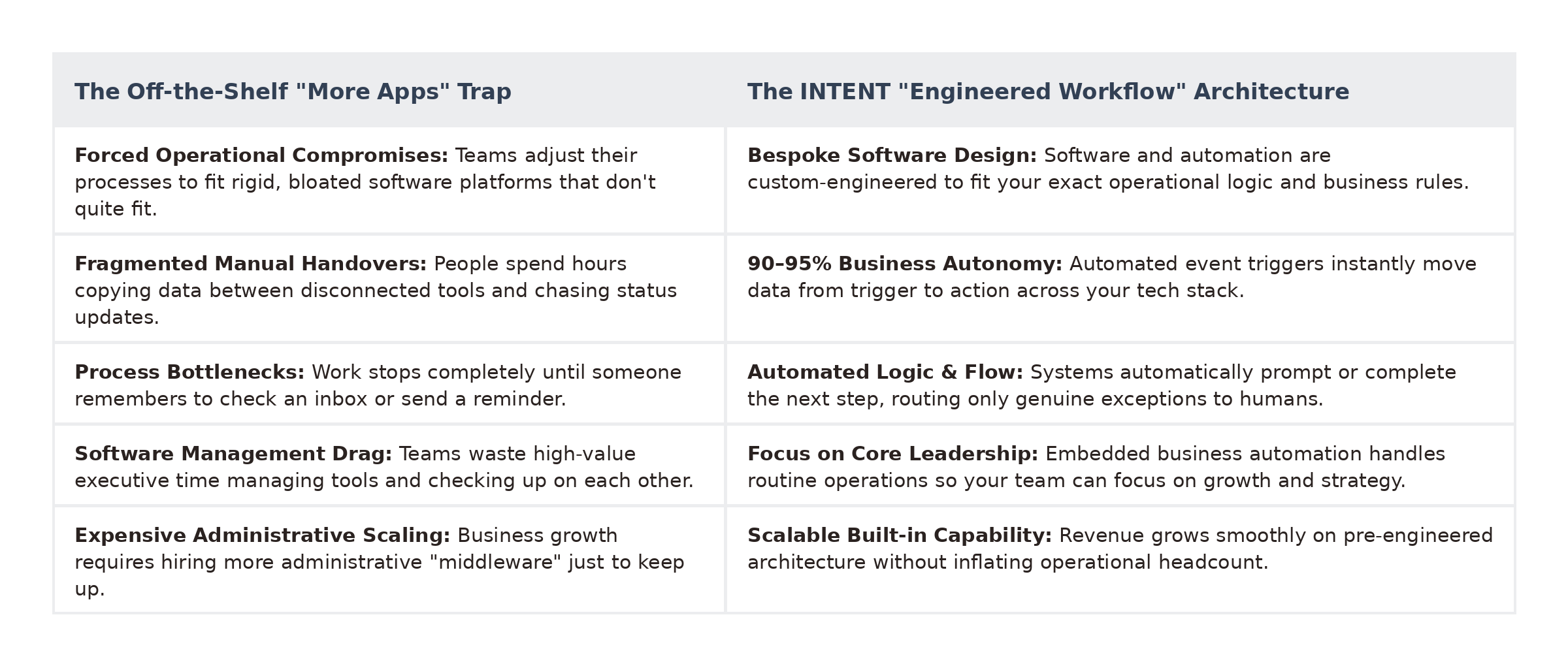
By replacing manual handovers with automated triggers and combining custom Workflow Architecture with embedded automation, businesses can achieve up to 90–95% operational autonomy. Routine approvals happen within the operational flow, data moves seamlessly between systems, and exceptions find the right human automatically.
And where off-the-shelf platforms fall short, INTENT designs and builds bespoke software systems engineered precisely to fit your exact operational logic, eliminating the compromises, clunky workarounds, and bloat of generic tools.
This delivers immediate ROI. Rather than enduring an eighteen-month, over-budget software rollout that doesn't quite fit and drains internal resources, precision workflow engineering cuts months off execution timelines and protects your core business performance from day one.
Stop Buying Software to Fix Process Failures
Your people bring judgment, creativity, leadership, and craft.
Don't waste their brilliance asking them to be human bridge-cables between disconnected software or expecting them to double-hat as full-time transformation leads.
Ready to Audit Your Handovers?
Take a look at your team's most frequent task this week.
Count how many times a human has to notify, copy, paste, or ping someone else just to keep the work moving... and start engineering those handovers out of the way.
If you suspect your team is spending more time managing software than driving real outcomes, let’s talk.
Through an INTENT Diagnostic session, we help you map out operational clutter, eliminate hidden handovers, and design an architecture that lets your business run with true autonomy.
