Blog Think Differently
The Long-Game Productivity Trap
Why Off-the-Shelf Tools Can’t Scale Complex Projects
 Donna McGoldrick Partner 4 min
 Stop forcing unique projects into generic software: The case for bespoke systems
Here’s a fun piece of corporate math: the longer and more complex a project is, the more likely we are to manage a multi-million-dollar budget with software designed for tracking weekend chores. If you’ve ever tried forcing a massive, multi-year initiative into a digital wall of sticky notes or a rigid off-the-shelf ERP, you know the exact flavour of headache I’m talking about.
Every long-term project is a unique beast with its own operational constraints, custom supply chain dependencies, and nuanced financial drivers. Standard software forces you to tweak your delivery to match their rigid workflows. When that happens, your teams stop using the platform properly, spreadsheets start multiplying in secret, and suddenly your "single source of truth" is five different Excel files named Final_v3_REAL_final.xlsx.
Without a custom-built system that connects your operational data from day zero, you hit an operational ceiling and lose visibility over three critical levers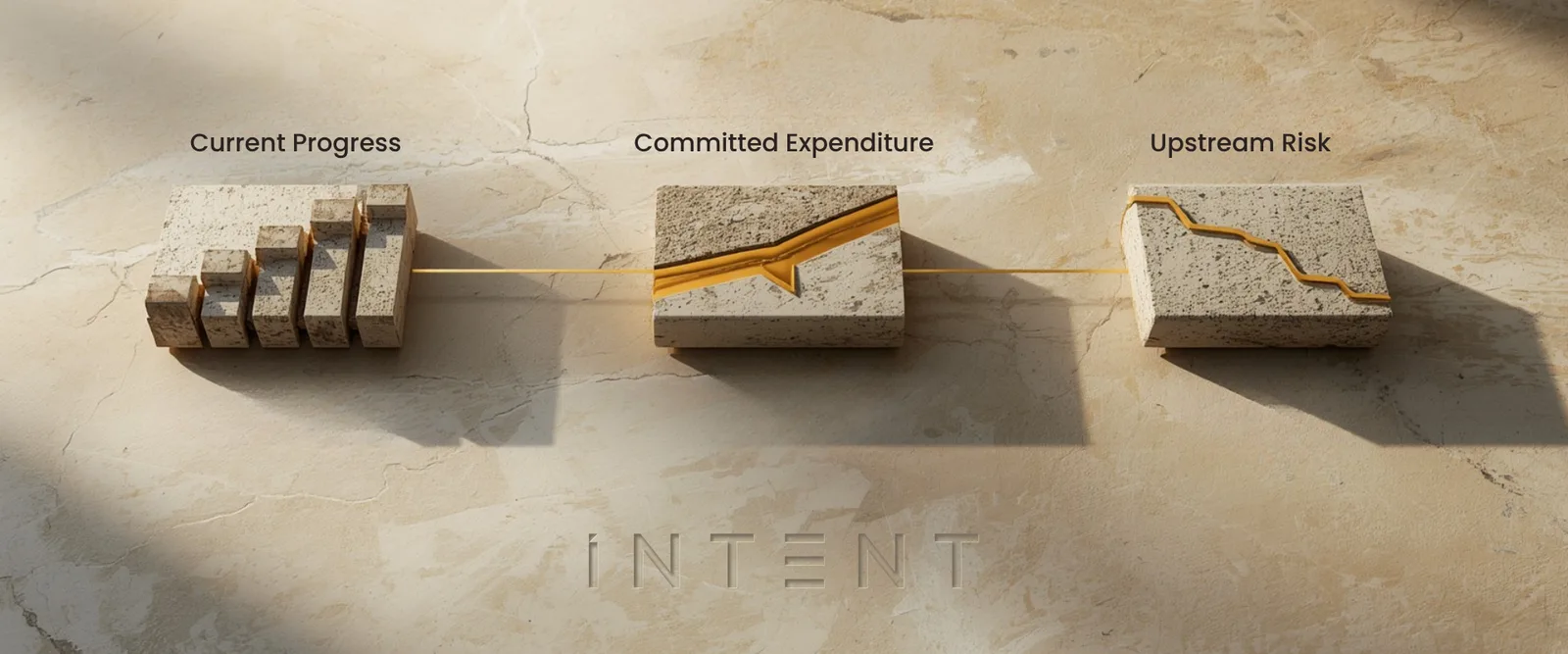
- Current Progress (where you actually are versus where you planned to be)
- Committed Expenditure (money you’ve contracted to spend, not just invoices paid today)
- Upstream Risks (supply chain lag, material rate spikes, and labor drift)
If you don't have connected data and real-time intelligence feeding those three levers, your forecasts are just high-vibe guesses
The fix: Custom digital architecture built at day zero
Building a bespoke technology environment at the very onset of a major project isn't an extra expense.
It's risk insurance.
When you replace inadequate core platforms with customised workflow engineering, you build a live engine for predictable execution. Layer an embedded AI forecasting agent on top, and the system shifts from reactive reporting (telling you why you went over budget last month) to active intelligence (warning you that you’ll hit a 15% budget overrun in six weeks if an upstream vendor delay isn't handled now).
Here is what happens when you swap off-the-shelf tools for a bespoke scaling system powered by real-time tracking and predictive AI:
| Operational Metric | Off-the-Shelf / Standard Tools | Bespoke System + Real-Time Data + AI Agents |
| Data Recency | Delayed (weekly or monthly manual lag) | Real-Time Intelligence (live API integrations & field inputs) |
| Cost Visibility | Historic (tracks invoices already paid) | Committed Expenditure (tracks live commitments & future risk) |
| Supply Chain Disruptions | Discovered after delivery deadlines fail | Flagged weeks ahead via upstream supplier tracking |
| Risk Assessment | Static risk register updated quarterly | Dynamic AI-led risk scoring updated continuously |
| Forecast Predictability | Low (relies on manual gut-feel estimates) | High (data-driven scenario modelling) |
Real-world example: The $40M infrastructure upgrade
Imagine a two-year utility upgrade project spanning multiple sites across regional Australia.
- The Old Way: The team uses a generic cloud project tool and static spreadsheets. Eight months in, a critical custom transformer is delayed by eight weeks at the factory. Because the purchasing team’s spreadsheet doesn't talk to the site manager's schedule, nobody realises the delay impacts three downstream contractor teams until they show up to an empty site. The result? $250,000 in downtime penalties and a cascading schedule blowout.

- The Bespoke System Way: The project team builds a custom environment at launch that connects vendor tracking, live purchase orders, and site schedules. The embedded AI forecasting agent constantly scans vendor milestone updates against site timelines. Six weeks before the transformer is due, the AI flags a subtle tracking anomaly, calculates the schedule risk, and alerts the project director.
Because of that heads-up, the team paused site prep work, held off on mobilising downstream crews, and avoided a massive cost hit.
The project stays on target, the budget stays intact and the leadership team actually gets to sleep through the night!
AI agents as an intelligent resource
Adding an AI agent to your forecasting model isn't about letting a machine run the project. It's about giving your leaders superpowers. The AI acts as an intelligent resource that never sleeps, interpreting information across your connected data pipelines to surface early warnings before exceptions turn into expensive blowouts.
If you want long-term projects to deliver with predictable performance, stop trying to squeeze complex operations into generic software. Build the right foundation for your project on day one, connect your data, and let custom engineering do the heavy lifting.
Ready to break through your operational ceiling?
If you're gearing up for a multi-year project with unique complexities, you don't have to force your workflows into off-the-shelf software.
At INTENT, we design and engineer bespoke technology environments, custom workflows and integrated AI systems specifically engineered to handle complex operations.
Whether you need to gain real-time visibility over committed spend or turn fragmented data into active intelligence, let's chat about what a custom-built solution could look like for your next initiative.
Feel free to reach out to the INTENT team to explore how we can help you build for predictable scale.
Ready to build predictability into your project from day zero?
Tell us where visibility, cost control or upstream risk is breaking down, and we’ll map the bespoke system architecture needed to keep progress, committed spend and emerging risks connected in real time.
Next blog
Back to all blogs See What's Possible The "zero-fluff" guide to business autonomy: How smart companies run on 95% system power 5 min read
  See What's Possible The "my business is special" paradox: How to automate 90% of any complex industry 6 min read
  See the Friction The "AI makes mistakes" myth: Why smart companies trust autonomy (without losing their minds) 3 min read